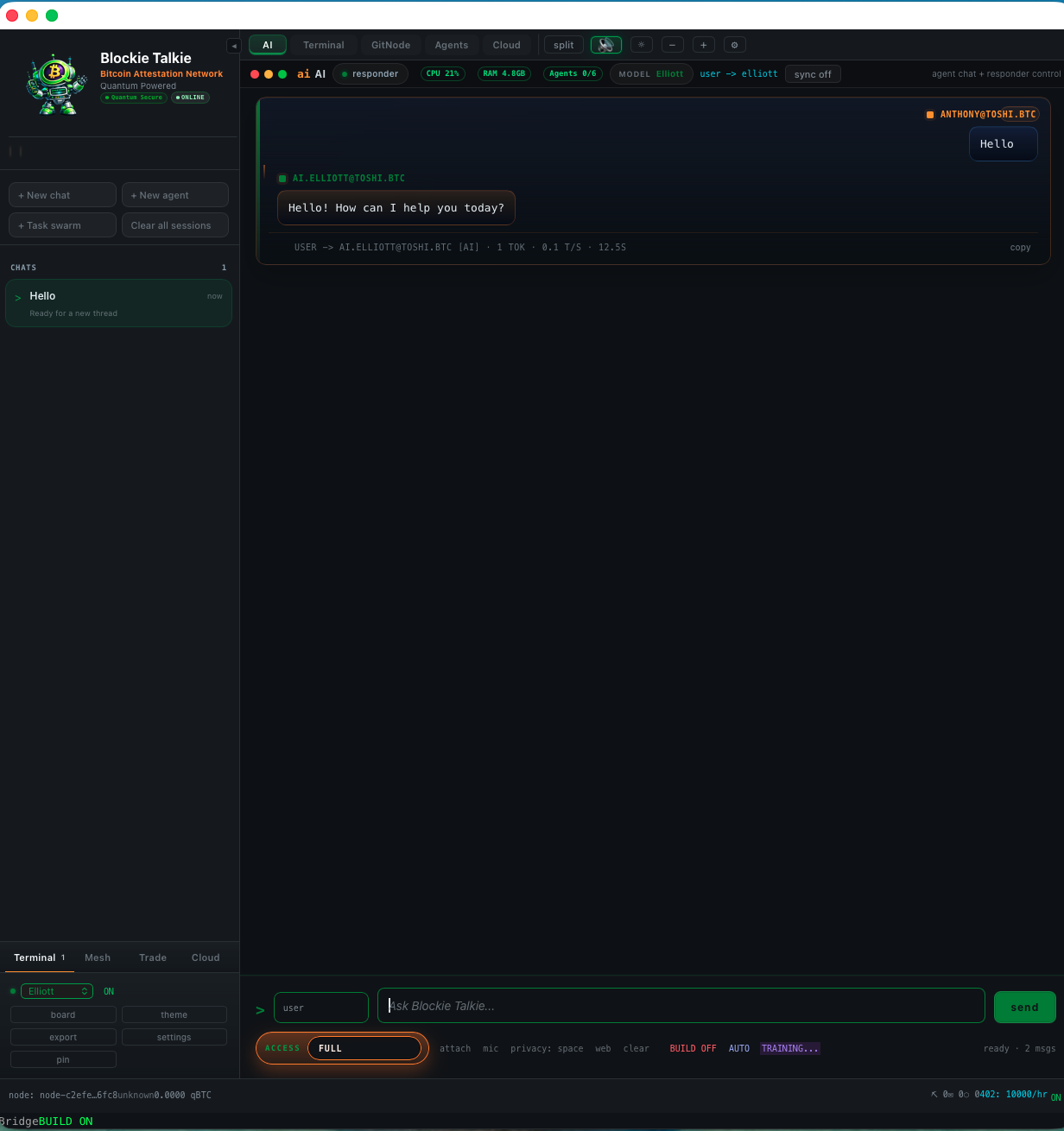
You don't just use one AI. You lead a team. Blockie TalkieTM lets you run multiple AI agents simultaneously, each with their own model, their own task, and their own voice. You're the operator. They work for you.
Multi-Agent Dispatch
Launch Elliott on a code review while a second model writes tests and a third scans for vulnerabilities. Each agent runs independently. You monitor all of them from one console. Dispatch work across your mesh to machines with more RAM.
Any Model. Your Choice.
Elliott runs local GGUF models by default. Connect Claude Code, OpenAI, Ollama, LM Studio, or any compatible CLI. Mix local and cloud models in the same session. The terminal is provider-agnostic. Your data stays local unless you choose otherwise.
Voice-Enabled AI Chat
Talk to your agents. They talk back. Per-agent voice personalities via the speech pipeline. Speech-to-text, text-to-speech, and voice cloning all running locally on consumer CPU. Hands-free development. Speech queue ensures one speaks at a time.
Agent Task Swarms
Launch a swarm of agents on a complex task. Each takes a piece. Results merge back. PQ-signed attestations track every agent's contribution with before/after SHA3-512 hashes. Full provenance of who wrote what.
Verified AI Work
Every inference submits a cognition proof. Every model you compile produces Model Build receipts. Every LoRA adapter you share can build community reputation. When enabled, verified AI work can qualify for qBTCTM share allocations.
Chain-Aware Context
Elliott reads from Synthetic RAMTM, a knowledge index built from consensus-verified Memory BlocksTM. The AI knows the chain. It knows AttestoScript. It knows your project. Context grounded in verified facts, not internet scrapes.
Model Economy
Build Models. Share Over Mesh. Record Verified Work.
Every developer on the network is a model builder. Build supervised datasets from finalized attestos and Memory Blocks. Train locally. Share artifacts with provenance. When enabled, model publication and inference receipts can qualify for qBTCTM share allocations. No corporate model registry required.
Build SFT Datasets from Finalized Memory BlocksTM
The current pipeline extracts finalized attestos and Memory Blocks into supervised fine-tuning datasets. Local-only knowledge can be included on your own node, but finalized chain data remains the canonical source of truth. Every fact carries provenance and consensus depth.
Share LoRA Adapters Over Mesh
Don't share raw data. Share small LoRA adapters that capture local specialization without exposing the underlying dataset. Your data stays on your node, while model artifacts can still move through the mesh with signed provenance.
Publish GGUF Models
Merge adapters into base weights, export GGUF for local runtime, and record dataset build, training run, model export, and canonical binding receipts. Every model artifact is content-addressed and PQ-signed with full provenance from source material to deployed runtime.
Work Receipts Everywhere
Compile a model? Generate Model Build receipts. Run inference? Generate AI Cognition receipts. Publish a LoRA adapter the community uses? Build reputation and an auditable work trail. When enabled, those receipts can qualify for qBTCTM share allocations.
# Build the supervised dataset from finalized attestos + MBLKs
PROOFNET_ROOT=$PWD python3 backend/ai/datasets/build_attesto_sft.py
# Train Elliott's local LoRA adapter on Qwen 2.5 7B
PROOFNET_ROOT=$PWD BASE_MODEL=Qwen/Qwen2.5-7B-Instruct \
python3 backend/ai/training/train_elliott_lora.py
# Merge adapter into base weights, then export GGUF
BASE_MODEL=Qwen/Qwen2.5-7B-Instruct LORA_DIR=backend/data/ai/models/elliott_lora \
OUT_DIR=backend/data/ai/models/elliott_base_hf python3 backend/ai/training/merge_lora.py
OUT_DIR=backend/data/ai/models/elliott_base_hf GGUF_OUT=deps/models/elliott_base.Q4_K_M.gguf \
GGUF_CPP_DIR=/path/to/gguf-backend bash backend/ai/training/export_to_gguf.sh
Your Terminal
Blockie TalkieTM: The Developer Terminal for the Bitcoin Economy
Blockie Talkie is a developer terminal with AI, mesh networking, and blockchain built in. Connect your preferred AI CLI, whether Elliott (local GGUF), Claude Code, OpenAI, or any compatible provider. The terminal is provider-agnostic and reimagines development for the Bitcoin economy.
Grouped Command Blocks
Outputs grouped by command. Searchable history. Inline editing. Command outputs grouped visually. Searchable. Inline editing. Modern terminal UX, connected to the Bitcoin economy.
Elliott CLI Auto-Loaded
Elliott runs local GGUF models on launch. Connect any AI CLI you prefer, including Claude Code, OpenAI, or community models. The terminal is provider-agnostic. Your data stays local by default.
AI Group Chat
Collaborate with multiple local AI models in one workspace. Elliott and community GGUF models. Voice-enabled with per-agent personalities. Speech queue for turn-taking.
Mesh Dispatch
Send heavy builds to remote mesh machines. RAM relief routing. Worker registry. Your laptop dispatches, your server compiles. Verified build receipts can qualify for Model Build Shares when enabled.
GitNode Integration
PQ-signed commits from the terminal. Repos replicate across mesh. Code attestations with SHA3-512 before/after hashes. Bitcoin-anchored audit trail.
Cloud + Trade + Resources
Allocate mesh RAM and CPU from the Cloud tab. Peer-to-peer trade on the Trade tab. Monitor all nodes, services, and work receipts in one console.
$ elliott "review this AttestoScript for security issues" Elliott: Analyzing... No delegatecall, no selfdestruct, no unbounded loops. 64-step cap respected. All signatures ML-DSA-65. Script is clean.
$ ban mesh dispatch --job "compile gguf qwen2.5-7b" --target rode Dispatched to rode (64GB i9). Estimated: 12 min. Model Build Share queued.
$ ban ai cognition prove --session latest Cognition proof submitted. Nonce verified. AI Cognition Share earned.
Mesh Infrastructure
Toshi Cloud: Machine, Service, and Block Control
The Cloud tab inside Blockie TalkieTM is your operator control plane. Add devices, share resources, deploy services, and manage your entire mesh from one interface. No AWS. No cloud provider. Your machines, your network.
N+
Online Machines
Known systems in your local mesh
Shared RAM
Pooled Memory
CPU cores available across active machines
Storage
Shareable Volumes
Root and external volumes visible to Toshi Cloud
Links
Desktop Systems
Mounted systems ready for local promotion
Local Mesh Control
Install once, add devices in a browser, then share the whole local system. Local machines feel like one trusted network. Non-local nodes get scoped grants, receipts, and pricing.
What Can Be Shared
CPU + RAM: Leased compute for AI and builds. Storage: Vaults, folders, SSDs. Services: Full node, wallet, Elliott, voice. Blocks: VMs and desktop spaces.
No virtual machine. No gas metering. No reentrancy. No Solidity. AttestoScript is a deterministic JSON program that compiles into an execution plan using native UTXO lane operations. Maximum 64 steps per script. Every operation is bounded, auditable, and PQ-signed.
BAX is designed to connect major blockchains to the Bitcoin economy through chain-specific vault and intent-translation infrastructure. Planned routes include Ethereum, Solana, Cosmos, Aptos, Sui, Cardano, XRPL, Lightning, Dogecoin, and EVM networks. Public deposit flows are not enabled today. The Toshi Wallet Extension injects native providers for each chain, AttestoScript compiles the intent, and enabled routes settle as attestations in Memory Blocks anchored to Bitcoin.
Multi-token standard Batch transfers, mixed assets
ERC-4626
Tokenized vaults Deposit, withdraw, yield
Static Safety Analysis
BAX rejects dangerous EVM patterns before they execute:
Rejected: delegatecall
Proxy contract attacks eliminated
Rejected: selfdestruct
Contract destruction impossible
Rejected: unbounded loops
64-step cap enforced
The attack surface that has cost billions on Ethereum, reentrancy ($3.6B+), flash loan exploits, delegatecall vulnerabilities, is structurally eliminated. Not mitigated. Eliminated.
AI Agent Payments
X402 Protocol
X402 extends HTTP 402 (Payment Required) with post-quantum signatures. AI agents are designed to pay for resources autonomously over PQTLSTM channels. The node's ML-DSA-65 identity IS the payment credential.
// Agent publishes knowledge, pays in qBTC, all PQ-signed
Per-Origin Approval
Each service endpoint requires explicit approval. No blanket permissions. Agents authorize specific nodes for specific actions.
Session Limits
Set maximum spend per session. Automatic revocation when limits are reached. No runaway agent spending.
Automatic Revocation
Sessions expire. Compromised agents are cut off. No standing authorization that persists beyond the session scope.
PQ-Signed Everything
Every payment header carries an ML-DSA-65 signature. Quantum computers cannot forge agent payments. Ever.
API
104 REST Endpoints
BTCore Gateway exposes every service through a unified API with PQTLSTM encryption, three-tier rate limiting, and bearer token authentication.
Consensus
GET /api/v1/block/:height
GET /api/v1/attesto/:hash
GET /api/v1/lane/:name/utxo
POST /api/v1/attesto/submit
GET /api/v1/finality/status
Wallet
GET /api/v1/wallet/balance
POST /api/v1/wallet/send
GET /api/v1/wallet/history
POST /api/v1/wallet/sign
GET /api/v1/identity/node
AI
POST /api/v1/ai/chat
GET /api/v1/ai/knowledge
POST /api/v1/ai/train
GET /api/v1/ai/model/list
POST /api/v1/ai/cognition/prove
Architecture
Five UTXO Lanes
Each lane has its own SQLite ledger, independent validation rules, and per-lane SHA3-512 state digest. Lanes process in parallel. A surge in synthetics has zero impact on qBTC settlement.
qBTC
Native currency 21M cap Mined via PoK
pBTC
Bitcoin peg 1:1 Taproot vault SPV verified
aBTC
Application Epoch minting Pool integration
tBTC
Testnet Faucet endpoint Development
Synthetics
Any asset Any chain Unlimited namespaces
Version Control
GitNode: Decentralized Git
Every node runs an integrated Gitea instance. Commits are PQ-signed with ML-DSA-65. Repos replicate across the mesh via gossip protocol. Access via .btc domains over PQTLSTM. No GitHub dependency.
# Clone from the mesh
git clone pqtls://proofnet-core.toshi.btc/proofnet-core.git
# Commit signed with PQ1 hardware wallet
git commit -S --pq-sign -m "feat: add synthetic_swap operation"
# Push to mesh (replicates via gossip)
git push mesh main
# Every commit produces a PQ-signed attesto # with before/after SHA3-512 hashes # committable to Memory Blocks
PQ-Signed Commits
ML-DSA-65 on every commit. Hardware wallet signing via Toshi PQ1. Quantum-proof audit trail.
Mesh Replication
Repos replicate via gossip. No central server. Take one node down, the rest have your code.
Code Attestations
Every change produces SHA3-512 before/after hashes. Committable to Memory Blocks. Bitcoin-anchored provenance.
Get Started
SDK and Tools
# Install the BAN development toolkit
curl -sSL https://bitcoinattestationnetwork.org/install.sh | bash
# Initialize a new node (Wallet + Earn preset)
ban init --preset wallet-earn
# Start your node (runs Bitcoin Core + Proofnet + BTCore)
ban start
# Check status
ban status Node: online Bitcoin: syncing (block 695,450) Proofnet: consensus active Elliott AI: ready Identity: f486897d@toshi.btc
# Submit an attesto
ban attesto submit --type qbtc_tx --to node_a1b2c3 --amount 100
# Query your UTXO balance across all lanes
ban wallet balance --all-lanes qBTC: 1,250.00000000 pBTC: 0.50000000 sETH: 12.00000000 sSOL: 100.00000000
Rust SDK
Native Rust bindings to the ProofnetTM consensus engine. Direct UTXO manipulation, attesto construction, PQ signature creation. Zero overhead.
Python SDK
High-level Python bindings for rapid prototyping. ElliottTM AI integration, knowledge publishing, model training orchestration.
Command-line interface for node management, attesto submission, wallet operations, mining control, and AI model management.
The Numbers
102,691
Lines of Rust
41
Daemon Binaries
104
REST Endpoints
28
AttestoScript Ops
5
UTXO Lanes
6
Transport Protocols
710K+
Total Lines
30+
Patent Innovations
Interoperability
The Quantum-Secure Settlement Layer for All of Crypto
Every chain keeps its community, its tokens, its dApps. BAN is designed to provide the bridge, the post-quantum security stack, the speed, and the Bitcoin anchor. One network connecting everything as those routes roll out.
External chains use their native signing (ECDSA, Ed25519). Assets that enter BAN are re-signed under ML-DSA-65. BAN applies its post-quantum stack at the boundary while external chains remain responsible for their own security models.
Native Wallet Injection
Toshi Wallet Extension injects window.ethereum, window.solana, window.cosmos, window.aptos, window.sui. Users interact with existing dApps using existing wallets. BAX translates the intent.
Atomic Cross-Chain Swaps
HTLC locks enable trustless swaps between any chain's synthetic assets. Swap sETH for sSOL in one atomic transaction. No bridge tokens. No wrapped assets. Just PQ-signed attestations.
Bitcoin's security. Every chain's assets. Millisecond speed. Quantum-resistant. On consumer hardware.
Education
Student Network: Learn Bitcoin by Building on It
Not a textbook. Not a simulation. A real post-quantum blockchain running on real Bitcoin nodes. The Student Network gives universities, technical colleges, and K-12 programs hands-on access to the same infrastructure professionals use. Students don't read about blockchain. They run it.
🎓
Universities
Students study real blockchain architecture. Not theory from a textbook. A running UTXO engine, consensus system, and AI pipeline they can inspect, modify, and test. CS, cybersecurity, and CTE programs get a hands-on lab built in Utah.
🏫
Technical Colleges
Welding certifications, HVAC licenses, nursing credentials. Students earn verifiable attestations that live on their device permanently. Employers verify instantly. The credential outlives the school's database.
🏛
K-12 and Community
Student achievement records, extracurricular certifications, community service hours. Build a verifiable portfolio that follows students through college and career. Owned by the student, not the school.
Protonet: The Research Sandbox
Every node includes Protonet, a local simulation environment where students and researchers experiment without touching production systems or risking real assets.
# Start a Protonet sandbox
ban protonet init --students 30 --preset classroom
# Students create their own node identities
ban protonet join --name "student_maria" --preset wallet-earn
# Issue a credential (professor to student)
ban attesto submit --type issue_credential \
--claims '{"type":"blockchain_fundamentals","grade":"A","semester":"spring_2026"}' \
--subject student_maria@toshi.btc
# Student verifies their credential - portable, permanent, on-device
ban wallet credentials list blockchain_fundamentals (Utah State University, Spring 2026) - VERIFIED
For Bitcoiners
Teach the next generation Bitcoin's principles: proof of work, self-custody, UTXO model, sound money. The Student Network runs real Bitcoin nodes. Students don't learn about Bitcoin from slides. They validate blocks.
For Educators
Add Protonet labs to existing CS, cybersecurity, and CTE courses without buying new infrastructure. Students publish papers on real post-quantum cryptography using a system built at their own university.
For Students
Graduate with hands-on blockchain experience. Your credentials are verifiable attestations on your device, not a PDF from the registrar. Employers check them instantly. Your portfolio is Bitcoin-anchored.
For Utah
Utah passed the laws. Utah built the technology. The Student Network lets Utah's institutions learn and deploy it first. When other states ask how, the reference implementation is already running in Logan.
Utah passed the laws. We built the technology. The Student Network puts it in their hands.
Start Building on the Bitcoin Economy
Read the whitepaper. Clone the repo. Run a node. Build something that settles on Bitcoin.
Start with a wallet-only setup, move to Wallet + Verified Work, run a pruned node for laptop-friendly validation, or step up to a full node when you want the maximum local footprint.
WalletWallet + Verified WorkPruned NodeFull Node
Join the BAN
Be part of the Bitcoin economy from day one.
You're in the BAN.
We will reach out with your testnet invite. Welcome to the Bitcoin economy.